


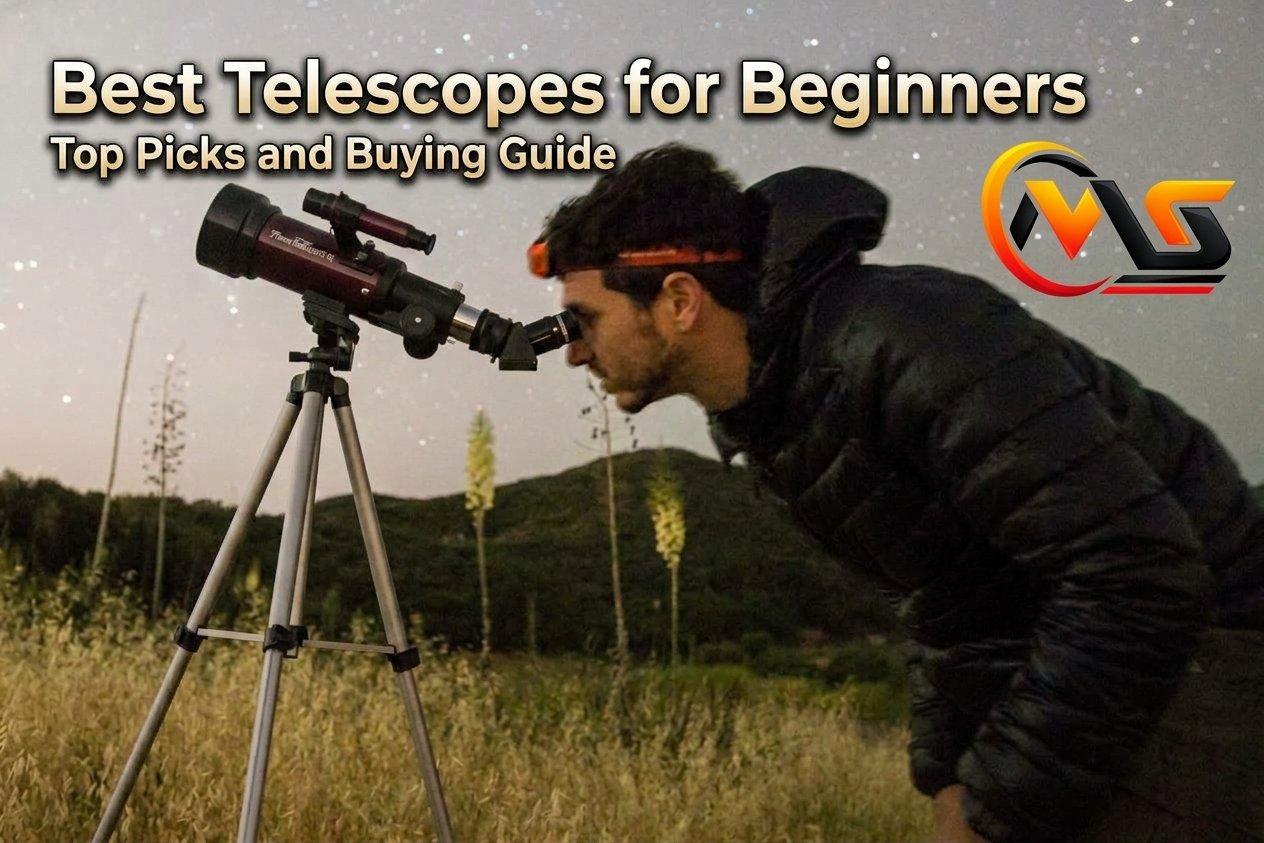
The Celestron AstroMaster 70AZ is one of the best telescopes for beginners who want to explore the night sky without dealing with complicated setup procedures. This beginner-friendly refractor telescope offers a simple way to observe the Moon, bright planets, and other prominent celestial objects. Its 70mm aperture gathers light for clear lunar views, while its straightforward design makes it easier for first-time users to get started. Whether you are introducing your family to astronomy or beginning a new stargazing hobby, the AstroMaster 70AZ provides a practical starting point for discovering the wonders of the night sky.
Its 70mm aperture gathers enough light for enjoyable views of the Moon, while its simple up-and-down and left-and-right movement makes it relatively easy to aim. Beginners can also explore bright planets and other prominent celestial objects when viewing conditions cooperate.
Best for: Adults, teenagers, and first-time astronomy enthusiasts who prefer a traditional telescope.
Main advantage: A simple design with relatively easy setup.
Potential drawback: Its smaller aperture limits the detail and faint objects it can reveal compared with larger telescopes.
2. Sky-Watcher Heritage 130P: Best for Deep-Sky Exploration on a Budget
The Sky-Watcher Heritage 130P is a tabletop Dobsonian-style reflector with a 130mm aperture. Its larger mirror collects substantially more light than a small beginner refractor, making it attractive to observers interested in more than the Moon and bright planets.
Under suitable conditions, beginners can explore star clusters, brighter nebulae, and other deep-sky targets. Its tabletop base is simple to operate, although you need a sturdy table or another suitable supporting surface.
Best for: Beginners who want stronger light-gathering performance and room to develop their astronomy skills.
Main advantage: A relatively large aperture for its size.
Potential drawback: You need a stable surface, and reflector optics may occasionally require alignment.
3. Celestron StarSense Explorer DX 130AZ: Best for Finding Objects
Finding a particular star or planet can be more difficult than expected when you first look through a telescope. The Celestron StarSense Explorer DX 130AZ addresses this challenge with smartphone-assisted sky navigation.
Its app-guided system helps users locate celestial targets without relying entirely on traditional star-hopping techniques. The 130mm aperture also provides useful light-gathering capability for planetary and brighter deep-sky observations.
Best for: Beginners who want help navigating the night sky.
Main advantage: Smartphone guidance makes locating targets more approachable.
Potential drawback: You must configure the system correctly, and smartphone compatibility can affect the experience.
4. Celestron Inspire 100AZ: Best for a Simple Refractor Experience
The Celestron Inspire 100AZ is a refractor option for beginners who want a larger lens and a relatively uncomplicated observing setup.
Its 100mm aperture can provide detailed lunar views and enjoyable observations of bright planets. Refractors also avoid the mirror-alignment process associated with many Newtonian reflectors.
Best for: Beginners who value straightforward operation and lunar or planetary viewing.
Main advantage: A practical combination of aperture and beginner-friendly handling.
Potential drawback: A refractor with a larger lens can cost more than a reflector offering comparable light-gathering ability.
5. Sky-Watcher Virtuoso GTi 150P: Best for Guided Tracking
The Sky-Watcher Virtuoso GTi 150P combines a 150mm reflector with a motorized, app-controlled mount. This design can help beginners locate and track celestial objects with less manual adjustment.
Its larger aperture makes it suitable for exploring the Moon, planets, star clusters, and selected deep-sky objects. However, the electronic features introduce additional setup steps and may require power.
Best for: Beginners willing to spend more for automated object finding and tracking.
Main advantage: A larger aperture paired with computerized assistance.
Potential drawback: Higher cost and greater dependence on electronics than a basic manual telescope.
Telescope Comparison Table
| Telescope | Best use | Aperture | Main feature |
|---|---|---|---|
| Celestron AstroMaster 70AZ | General beginner viewing | 70mm | Simple operation |
| Sky-Watcher Heritage 130P | Deep-sky exploration | 130mm | Tabletop Dobsonian |
| Celestron StarSense Explorer DX 130AZ | Finding celestial objects | 130mm | Smartphone guidance |
| Celestron Inspire 100AZ | Moon and planets | 100mm | Refractor design |
| Sky-Watcher Virtuoso GTi 150P | Guided observations | 150mm | Motorized tracking |
These models serve different purposes, so the most suitable choice depends on your observing goals, available space, and budget rather than the model name alone.
Refractor vs. Reflector: Which Is Better for Beginners?
Understanding telescope designs helps you avoid buying equipment that does not match your interests.
A refractor telescope uses lenses to gather and focus light. It generally requires little routine optical maintenance and works well for lunar and planetary viewing. However, larger refractors can become expensive.
A reflector telescope uses mirrors and often offers more aperture for the money. This makes reflectors appealing for viewing faint objects beyond the solar system. Some designs require occasional mirror alignment, known as collimation.
A Dobsonian telescope is a reflector mounted on a simple base designed for easy manual movement. It is particularly popular among beginners who want a larger aperture without spending heavily on computerized equipment.
For many newcomers, a 130mm tabletop Dobsonian provides a useful balance between performance, portability, and cost. Those who prioritize simple maintenance may prefer a refractor.
How Much Should You Spend on Your First Telescope?
Your budget should reflect how seriously you want to pursue astronomy.
- Entry-level budget: Consider a basic refractor for learning the fundamentals and viewing the Moon.
- Midrange budget: Explore larger-aperture reflectors that reveal more detail and brighter deep-sky targets.
- Higher budget: Consider computerized telescopes if automated navigation and tracking are important to you.
Remember to include essential accessories, such as additional eyepieces if needed, a suitable support surface, and a protective carrying case.
Avoid spending extra money simply because a telescope advertises extremely high magnification. Optical quality, aperture, and atmospheric conditions determine how useful magnification will be in practice.
Common Telescope-Buying Mistakes to Avoid
First-time buyers frequently focus on specifications that sound impressive but do not guarantee good results.
Watch out for these mistakes:
- Choosing maximum magnification over aperture: Excessive magnification can make an image dim and blurry.
- Ignoring mount quality: An unstable tripod makes focusing and tracking frustrating.
- Expecting professional photographs: Visual telescopes and astrophotography equipment serve different needs.
- Buying based on appearance: A telescope that looks advanced may still have weak optics or poor construction.
- Ignoring portability: A large instrument is less useful if you rarely want to move it.
- Overlooking the learning curve: Computerized systems can help, but they also introduce setup requirements.
A sensible first telescope should encourage you to observe regularly rather than leave you struggling with equipment.
What Can You See With a Beginner Telescope?
A good starter telescope can reveal more than many people expect.
- The Moon: Observe craters, mountain ranges, and the boundary between lunar day and night.
- Jupiter: Depending on aperture and conditions, you may see its four largest moons and some cloud-band detail.
- Saturn: A suitable telescope can reveal its rings when the planet is well positioned.
- Star clusters: Some bright clusters become attractive collections of individual stars.
- Nebulae: Bright nebulae may appear as faint, grayish patches rather than colorful photographs.
- Double stars: Some pairs of stars can be separated into distinct points of light.
Your results will depend on aperture, atmospheric stability, light pollution, and observing experience. Images seen online often involve long-exposure photography, so they may look very different from what your eyes see through an eyepiece.
Frequently Asked Questions
What is the best telescope for beginners?
The best choice depends on your budget and goals. A simple refractor suits easy lunar viewing, while a 130mm tabletop Dobsonian offers greater light-gathering ability for exploring more celestial objects.
Can beginners see Saturn’s rings?
Yes. A suitable beginner telescope can reveal Saturn’s rings when viewing conditions are favorable. The planet may appear small, and the amount of visible detail depends on the telescope and atmospheric conditions.
Is a 70mm telescope good for beginners?
A 70mm telescope can be a useful first instrument for viewing the Moon, bright planets, and selected star clusters. It is portable and relatively easy to learn, although its smaller aperture limits faint-object performance.
Is a reflector or refractor better for a beginner?
A refractor is attractive for simple operation and low routine maintenance. A reflector generally offers more aperture for the money, making it a strong option for beginners interested in deep-sky observing.
Can I use a beginner telescope for astrophotography?
Some beginner telescopes support basic lunar and planetary photography with suitable adapters. Photographing faint galaxies and nebulae usually requires more specialized equipment, accurate tracking, and additional practice.
Conclusion
Choosing among the best telescopes for beginners becomes easier when you focus on your actual observing goals rather than marketing claims. The Celestron AstroMaster 70AZ offers a straightforward introduction, the Sky-Watcher Heritage 130P provides greater light-gathering ability, and the StarSense Explorer DX 130AZ helps beginners locate objects. If automated tracking matters most, the Virtuoso GTi 150P is worth considering. Start with a stable, manageable telescope, learn to recognize a few bright celestial targets, and gradually expand your skills. The best first telescope is one that fits your budget and inspires you to keep exploring the night sky.
Also Read: @ SimplySeven.net/: A Complete Guide to Its Website, Content, and Purpose
