

Artificial intelligence has changed digital image creation faster than most people expected. What once required advanced editing skills can now be accomplished through simple text prompts and automated tools. Among the more controversial developments is NSFW AI, a broad term covering AI systems that generate, edit, classify, or moderate adult-oriented visual content. While the technology attracts attention because of its unusual capabilities, understanding how it works is more important than simply focusing on what it can produce.
An NSFW AI image editor combines AI image editing, computer vision, and generative technology to modify or transform visual content. Some tools work with existing images, while others combine editing features with an NSFW AI image generator to create new AI-generated visuals.
Before exploring these tools, there are several important points to understand:
- NSFW AI image editors can offer different features depending on the model and platform.
- An image editor generally modifies existing material, while a generator focuses on creating new AI-generated images.
- AI safety filters and moderation systems can restrict sensitive content.
- Privacy and consent become particularly important when real people’s images or likenesses are involved.
- AI-generated results are not always accurate and may contain visual inconsistencies.
- Laws, platform rules, and AI regulations can differ depending on location.
What Is an NSFW AI Image Editor?
An NSFW AI image editor is an AI-powered tool designed to process, modify, or transform adult-oriented images. Instead of relying entirely on traditional manual editing, these systems use machine learning models to understand visual information and predict suitable changes.
Some platforms concentrate on NSFW AI image generation, while others focus on editing an image that the user has already provided. There are also services that combine both approaches.
The technology behind these tools can include generative AI, deep learning, computer vision, and automated image-processing systems. Their capabilities can range from basic visual adjustments to more advanced AI image transformation.
How Does an NSFW AI Image Editor Work?
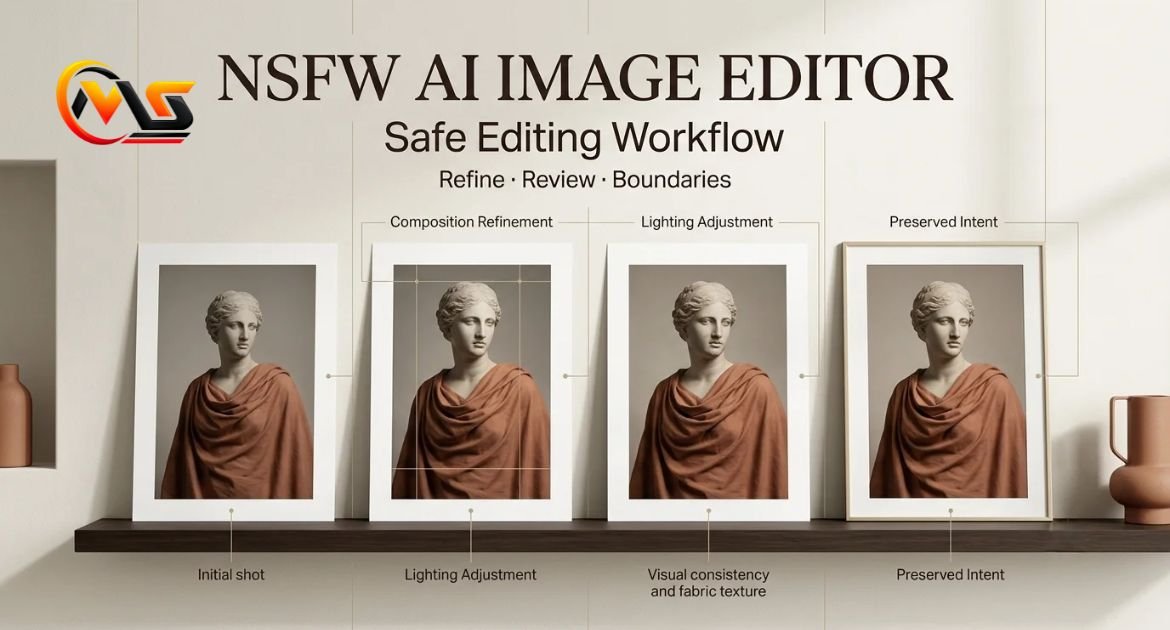
Although the technology behind these systems can be complex, the basic workflow is relatively easy to understand. The AI receives an image, a text prompt, or both and analyzes the available information before producing a modified result.
A typical workflow looks like this:
- The user provides an image or text prompt.
- The system analyzes the visual information through computer vision.
- Pattern recognition helps the model identify important elements within the image.
- A generative model predicts and creates the requested visual changes.
- Content detection or moderation systems may check the input or output.
- The final result is generated and displayed.
Many systems also use natural language processing to understand text prompts. More advanced platforms use multimodal AI, allowing the system to work with both text and images at the same time.
Where Do AI-Generated NSFW Images Come From?
AI-generated NSFW content is created by generative models trained on large collections of visual information. During training, models analyze image datasets and learn relationships between shapes, textures, colors, lighting, and other visual patterns.
When a user enters a prompt, the model uses what it learned during training to generate a new result. It does not necessarily work like a conventional search engine that simply retrieves an existing photograph.
Different services may use proprietary technology or open-source AI models, which is one reason results can differ significantly between platforms.
The quality and source of training data are also important. Responsible developers need to consider how AI training datasets are collected and whether personal or copyrighted material has been handled appropriately.
Key Features of NSFW AI Image Editors
The exact feature set varies from one tool to another, but modern platforms can include several AI-powered functions.
Common features may include:
- AI-powered image editing
- Image-to-image transformation
- Text-prompt-based editing
- AI image generation
- Visual enhancement
- Background modification
- Style transformation
- Automated nudity detection
- NSFW content filtering
- AI moderation controls
- Privacy settings
Some platforms also use AI moderation tools to identify sensitive material before it is processed, published, or shared.
For users, the most useful feature is not necessarily the largest number of editing options. Clear privacy policies, reliable safety controls, and transparent data practices can be equally important.
What Can NSFW AI Image Editors Do?
The capabilities of an NSFW AI image editor depend on its underlying model. Some tools are designed mainly for transforming existing images, while others include adult content generator functions.
In general, AI image technology can automate visual changes, create variations, modify selected elements, and generate new artwork from text prompts.
However, AI has limitations. Generated images can contain distorted details, inconsistent anatomy, unusual backgrounds, or other visual errors. Even highly realistic AI-generated images should therefore be reviewed carefully rather than automatically treated as authentic photographs.
| Capability | Main Advantage | Common Limitation |
|---|---|---|
| AI image editing | Faster visual changes | Results may be inconsistent |
| Image generation | Creates new concepts | Quality varies by model |
| Text prompts | Easy to use | AI may misunderstand instructions |
| Automation | Saves editing time | Less precise than expert editing |
| Content detection | Supports moderation | Detection is not perfect |
| Safety filters | Helps restrict risky content | Rules differ between platforms |
Benefits and Limitations of NSFW AI Image Editing
One major benefit of AI image editing is efficiency. A task that could take considerable time in conventional software may be completed much faster through automated processing.
AI also makes experimentation easier. Users without advanced graphic-design skills can explore AI image generation and visual transformation through simple instructions.
However, there are important limitations. Results can vary, some platforms have strict restrictions, and uploaded images may raise data usage and privacy concerns. There can also be problems involving consent, misuse, copyright, and inaccurate representations.
For this reason, AI safety should be considered alongside convenience and creative possibilities.
Common Uses of NSFW AI Image Editors
The technology can have different applications depending on the platform and its rules. Some users explore mature digital artwork, fictional characters, creative concepts, and visual experimentation.
Related AI systems can also be used for NSFW content detection. Websites and online communities may use automated moderation systems to identify sensitive imagery and determine whether it should be restricted, reviewed, or removed.
This demonstrates that similar AI technology can have both creative and protective applications. A system that generates images and another system that detects inappropriate images may use related computer-vision techniques while serving completely different purposes.
Privacy, Consent, and Data Usage
Privacy is one of the most important considerations when using any AI image editing service. Before uploading an image, users should understand how the platform handles files, generated results, and personal data.
Important questions include whether uploaded images are stored, whether they are used for model training, how long they remain on the service, and whether users can delete them.
Consent is equally important. A person’s photograph or likeness should not be used to create adult-oriented material without permission. Doing so can result in serious privacy violations and potentially legal consequences.
Choosing privacy-focused AI tools, checking data policies, and avoiding unnecessary uploads are practical ways to improve AI image privacy.
Legal and Ethical Considerations
The legal environment surrounding AI-generated adult material is still developing. Different countries can have different rules concerning privacy, copyright, manipulated images, deepfakes, and online distribution.
A particularly serious concern is deepfake pornography, especially when the likeness of a real person is used without consent. Such misuse can cause harassment, reputational damage, and emotional distress.
There is also a wider question of ethical AI. Technology should be evaluated not only by what it can technically accomplish but also by how it affects real people.
Responsible development therefore involves AI ethics, digital ethics, privacy, consent, platform safety, and clear legal boundaries.
How to Use NSFW AI Image Editors Responsibly
Responsible use begins with selecting a platform that clearly explains its policies and provides appropriate safety controls.
Users should:
- Review the platform’s privacy and data policies.
- Avoid uploading sensitive personal images unnecessarily.
- Respect consent when using another person’s likeness.
- Keep available safety filters enabled.
- Follow the platform’s content rules.
- Understand relevant laws and global AI policies.
- Avoid distributing content that could deceive, harass, or harm another person.
These practices support responsible AI image editing and contribute to safer digital environments.
Common Misconceptions About NSFW AI
One common misconception is that every NSFW AI image generator works in exactly the same way. In reality, models, features, restrictions, and moderation systems can differ substantially.
Another misconception is that AI-generated images are always realistic. Modern models can produce impressive results, but they can still make mistakes involving faces, anatomy, lighting, objects, and backgrounds.
It is also incorrect to assume that AI removes responsibility from its users. People remain responsible for how they create, store, share, and distribute AI-generated material.
Finally, NSFW AI is not limited to image generation. Related technologies can also support AI content moderation, content detection, safety research, and platform protection.
The Future of NSFW AI Image Editing
The future of NSFW AI image editing will likely involve improvements in both generation capabilities and safety technology. Models are becoming better at understanding complex instructions, while moderation systems are becoming more capable of identifying sensitive or manipulated content.
Future services may introduce stronger privacy controls, clearer consent mechanisms, improved explicit image detection, better user reporting, and greater transparency around training datasets.
At the same time, governments and technology companies will continue developing AI regulations and legal frameworks concerning generated and manipulated content.
Ultimately, the future of this technology will not be determined only by how realistic AI can make an image. AI-generated content safety, privacy, consent, and user safety will be equally important.
FAQS
What is an NSFW AI image editor?
An NSFW AI image editor is an AI-based tool designed to modify, transform, or create adult-oriented images. Features vary between platforms.
Is NSFW AI image editing safe?
Safety depends on the platform, its privacy practices, moderation systems, and how the technology is used. Users should carefully review privacy and safety policies.
What is the difference between an NSFW AI image generator and editor?
A generator primarily creates new images from prompts or other inputs, while an editor focuses on modifying existing images. Some platforms combine both functions.
Can NSFW AI create realistic images?
Modern generative AI can create highly detailed images, but results can still contain visual errors and should not automatically be treated as authentic photographs.
Why are consent and privacy important?
AI can manipulate a person’s likeness very convincingly. Using someone’s image for adult-oriented content without consent can create serious privacy, ethical, and potentially legal problems.
What are AI safety filters?
AI safety filters are automated safeguards designed to detect, restrict, or block certain types of content. They are commonly used as part of broader content filtering and moderation systems.
Conclusion
An NSFW AI image editor is part of a rapidly developing area of artificial intelligence that combines image editing, generation, computer vision, and content moderation. Its ability to automate visual tasks can make image creation and transformation faster, but that convenience also comes with important responsibilities.
Privacy, consent, data protection, ethical AI practices, and legal requirements should remain central whenever sensitive imagery is involved. Understanding these factors allows users to look beyond the technology’s novelty and make more informed decisions.
As NSFW AI image editing continues to develop, the most valuable progress will not simply be better image quality. It will be the development of tools that balance innovation and digital expression with responsible use, strong privacy protections, and respect for people’s rights.
Also Read: Best Laptop for Business and Personal Use: Top Picks for Work and Everyday Tasks
